| Location: | El Salvador |
|---|---|
| Authors: | Rochelle Campbell (HRC), Celina Kattan (Senior Consultant), Jacqueline Yamileth Rivera Ayala (MARN), Carolina Rivas Rivas (MARN), Daniel Beardsley (US-NWS), A. Sezin Tokar (USAID) |
| Publication/Conference | American Meteorological Society (AMS) Annual Meeting 2022, Oral Presentation |
Risk communication is a critical component of impact based forecasting and early warning under the Weather Ready Nations (WRNs) projects. Communication aims to influence the recipient’s response to the hazardous events and understand potential impacts to foster preparedness in individuals, groups, and institutions in mobilization (wanting to act) and empowerment (knowing what to do), thus mitigating the effects of severe hydrometeorological events. While the move towards more relatable weather warning messaging is a positive one, risk communication is a complex, dynamic and interactive process that is highly dependent on audience psychology, knowledge, skills, and capabilities, presenting at once difficulties and opportunities for agencies.
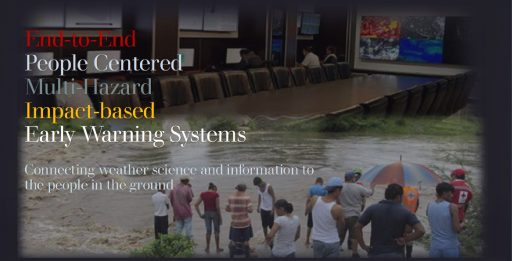
Recognizing the importance of bridging the communication gaps that can exist between forecasters and their audiences, the Salvadoran Ministry of Environment and Natural Resources (MARN, by its acronym in Spanish) has implemented a Weather Ready Nations (WRNs) project with the support of the U.S. National Weather Service-International Affairs Office (NWS-IA) and the U.S. Agency for International Development/Bureau for Humanitarian Assistance (USAID/BHA). MARN began training and working with community leaders under their “Local Observers Program”, a group of volunteer citizens and community leaders who live or work in areas of high risk, to improve and tailor impact-based forecasts (IBF) according to their needs. These partners contribute to disseminating the impact-based forecast information, promoting protective actions, and providing both verification of events and local knowledge and experience. Their connection to the local community means they are also trusted sources of critical weather information that saves lives.
We investigated the challenges and benefits of the IBF as perceived by the observers within El Salvador. Interviews and workshops were held with meteorologists, hydrologists, and observers. We found that the benefits of implementing IBF for the observers included a perceived increase in the understanding of the potential impacts, perceived increase in accuracy, relevance, and timeliness, informed decision making, and increased mitigation actions. Benefits for MARN included added awareness of antecedent conditions by forecasters, integration of different information and processes, improved communication amongst meteorologists, hydrologists, and geologists, and enhanced partnerships with various stakeholders and actors. Overall, the WRNs approach contributed to developing capacity along the entire service delivery chain. Challenges identified by the participants included a lack of impact data, verification of warnings based on impacts, and a need for additional timely information for specific hazards such as flash floods. We argue that IBF can be designed for trained observers with an increased focus on understanding vulnerability and capacities. More impact data needs to be collected and stored to inform future warnings.